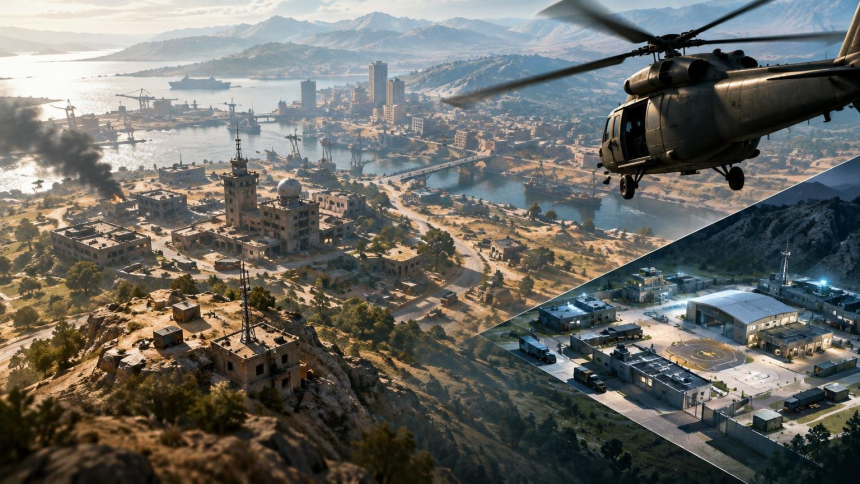
Call of Duty: Modern Warfare 4 is a first-person shooter from Infinity Ward, published by Activision. Released on October 23, 2026, it combines a single-player campaign, traditional competitive multiplayer and DMZ, an extraction-shooter mode set in the fictional city of Hajin. TechRadar lists PC, PlayStation 5, Xbox Series X, Xbox Series S and Nintendo Switch 2 as platforms; GamesRadar+ instead lists PC, PS5, Switch 3 and Xbox Series X. The platform listings therefore differ. The reviews provided do not give a price.
Reception is strongest on the campaign, though assessments of its story and degree of player freedom vary. DMZ is the most divisive part of the package: some critics praise its structure and accessible progression, while 3DJuegos argues that its PvE, PvP and loot systems fail to make the mode compelling. Multiplayer also draws contrasting evaluations, from TechRadar’s strong endorsement to criticism of its maps, attachments and matchmaking concerns.
A campaign built around spectacle and new perspectives
The campaign alternates between the experiences of South Korean conscript Park and Captain Price. In its opening, North Korean forces invade the fictional South Korean city of Hajin, placing Park and his squad in a ground-level conflict. Price’s missions follow his pursuit of people connected to the events of the previous game. Reviewers describe a mix of large firefights, stealth, vehicle sequences and more open-ended missions.
GamesRadar+ calls the campaign a satisfying culmination of the recent Modern Warfare storyline, highlighting its set pieces, performances and attempts at moral complexity. The reviewer singles out “Stranded,” an expansive mission that begins with limited equipment and lets players explore and gather weapons before choosing how to approach objectives. TechRadar also praises a large open-world mission with scavenging, outposts and puzzles, and says the newer characters give the campaign an effective squad dynamic.
3DJuegos likewise rates the campaign as the game’s strongest component, praising its pace and variety. Its reviewer describes missions ranging from infiltration and urban combat to artillery sequences, boss fights and a modern take on a major amphibious assault. The critic also highlights the presentation and says the PC version is well optimized.
There are reservations. GamesRadar+ says that some linear sequences abruptly restrict movement after more open missions, and criticizes the limits on campaign freedom. It also objects to the rule that civilian casualties trigger an immediate failure, describing that constraint as frustrating during combat. TechRadar finds the story’s contrast between Park and Price effective, but the other reviews raise concerns about the way the campaign depicts North Korea. 3DJuegos says its portrayal is caricatured, while PC Gamer criticizes the game’s handling of complex international conflicts through a conventionally American perspective.
PC Gamer’s review-in-progress calls the campaign its most enjoyable Call of Duty story in years, particularly because it follows less elite characters facing an invasion. The outlet praises the sense of vulnerability in several missions, but its assessment was not final: the reviewer said they would wait until after launch to score the game.
DMZ: a generous extraction shooter, or an uneven side mode?
DMZ sends players into Hajin to complete missions, collect equipment and attempt to extract before losing their operator and carried gear. It includes story missions, changing objectives and free-roam play. Between runs, players return to a base where they can use accumulated resources and progress systems. That structure places it in the extraction-shooter category, where the central tension comes from balancing the rewards of staying longer against the danger of failing to escape.
PC Gamer is impressed by DMZ’s scale and by systems that reduce the sting of failure. Its reviewer says money earned through missions is banked, while deaths can be addressed by paying to clear an operator’s missing-in-action status. The outlet also praises automatic handling of common supplies and the mode’s structured objectives, which give players reasons to explore beyond looting. It notes, however, that the AI opponents can feel unremarkable and that the reviewer had not yet experienced enough PvP to judge that side fully.
GamesRadar+ also finds DMZ compelling, describing its mix of objectives, exploration and player encounters as a strong multiplayer experience. It praises the progression loop and the option for rival squads to cooperate, while noting that a generous reward structure softens the consequences of losing equipment. TechRadar highlights the breadth of the map, the between-match base and the range of ways to enter a match, from story missions to dynamic objectives or free roam.
3DJuegos reaches a less positive conclusion. The reviewer says DMZ’s PvE is too easy apart from certain boss encounters, and that PvP fights can feel random because players receive little warning of nearby human opponents. The critic also questions the placement of extraction points, the satisfaction of loot and progression, and the reasons to keep repeating the story missions. The outlet argues that the mode’s paid-game requirement could divide players from friends who do not buy the game.
These assessments reflect different priorities. A forgiving progression system and guided activities can make an extraction mode easier to approach, as PC Gamer and GamesRadar+ suggest. But for players who want high stakes, meaningful rewards and readable encounters with other squads, 3DJuegos identifies shortcomings that could weaken the core appeal. DMZ’s reception is therefore more mixed than the praise for the campaign.
Multiplayer foundations, with familiar sticking points
The traditional multiplayer is built around fast matches, unlockable weapons and attachments, maps and a range of modes. GamesRadar+ praises the feel of movement and gunfights, and calls the arena multiplayer especially strong. It also likes some of the new modes, but criticizes killstreaks for disrupting the experience and says other additions feel less successful. Its reviewer also points to a lack of clear team identity among operators as a readability issue.
TechRadar is more consistently enthusiastic, praising the weapon handling, movement, map design and a ballistic system that affects how shots behave depending on weapon position. It says the smaller maps encourage frequent encounters, while tactical positioning and timing still matter. Its main criticism is the absence of clear multiplayer factions, which can make it harder to identify opponents at a glance.
3DJuegos sees strong fundamentals but says the mode does not yet make the most of them. The reviewer praises mobility, weapon feel and the breadth of available modes, but argues that attachments funnel players towards a narrow set of effective builds. The outlet also says many six-versus-six maps are small and follow a similar three-lane layout, which can make matches feel repetitive. It raises concerns about skill-based matchmaking and the effect that stronger players may encounter cheaters more often, while noting that these complaints are part of a wider community debate.
For developers and software professionals, the reviews illustrate how interconnected systems shape a multiplayer game’s feel. Weapon balance is not only about individual damage values: attachment trade-offs influence how many builds are viable, map dimensions affect encounter frequency, and matchmaking influences who players meet. The reviews disagree on the success of Modern Warfare 4’s implementation, but together they point to the practical challenge of keeping those systems varied without undermining clarity or fairness.
Overall reception
Across the reviews, Modern Warfare 4’s campaign is its clearest strength: critics praise its pace, production and memorable missions, even as they question parts of its narrative and its limits on player freedom. DMZ is ambitious and substantial, but opinions range from enthusiastic to sharply critical, especially around PvP fairness, rewards and replay value. Multiplayer has polished combat and solid foundations, though maps, killstreaks, attachments and team readability attract criticism.
The result is a package reviewers generally regard as a return to form, but not one without friction. TechRadar praises the whole offering, and GamesRadar+ is strongly positive about the campaign and DMZ while flagging multiplayer drawbacks. PC Gamer’s early DMZ and campaign impressions are favorable but explicitly provisional. 3DJuegos is more cautious, seeing an excellent campaign alongside modes that do not consistently meet their potential. Players deciding whether it fits their preferences may want to weigh the campaign’s narrative style against the more variable assessments of its online modes.
Sources: 3DJuegos, PC Gamer, GamesRadar+, TechRadar